Urea-formaldehyde (UF), also known as urea-methanal, so named for its common synthesis pathway and overall structure,[1] is a nontransparent thermosetting resin or polymer. It is produced from urea and formaldehyde. These resins are used in adhesives, finishes, particle board, medium-density fibreboard (MDF), and molded objects.
UF and related amino resins are a class of thermosetting resins of which urea-formaldehyde resins make up 80% produced worldwide. Examples of amino resins use include in automobile tires to improve the bonding of rubber to tire cord, in paper for improving tear strength, in molding electrical devices, jar caps, etc.[2]
Properties
Urea-formaldehyde resin's attributes include high tensile strength, flexural modulus, high heat-distortion temperature, low water absorption, mould shrinkage, high surface hardness, elongation at break, and volume resistance. It has a refractive index of 1.55.[3]
Chemical structure
The chemical structure of UF polymer consists of [(O)CNHCH2NH]n repeat units. In contrast, melamine-formaldehyde resins feature NCH2OCH2N repeat units. Depending on the polymerization conditions, some branching can occur. Early stages in the reaction of formaldehyde and urea produce bis(hydroxymethyl)urea.

Production
About 20 million metric tons of UF are produced annually. Over 70% of this production is then put into use by the forest-products industry for bonding particleboard, MDF, hardwood plywood, and laminating adhesive.
General uses
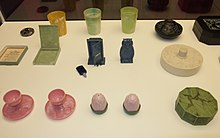
Urea-formaldehyde is pervasive. Examples include decorative laminates, textiles, paper, foundry sand molds, wrinkle-resistant fabrics, cotton blends, rayon, corduroy, etc. It is also used as wood glue. UF was commonly used when producing electrical appliances casing (e.g. desk lamps). Foams have been used as artificial snow in movies.
Agricultural use
UF is also used in agriculture as a slow-release source of nitrogen. Its rate of decomposition into CO
2 and NH
3 is determined by the action of microbes found naturally in most soils.[4] The activity of these microbes, and the rate of ammonia release, is temperature-dependent. The optimum temperature for microbe activity is around 70–90 °F (21–32 °C).[5]
Foam insulation
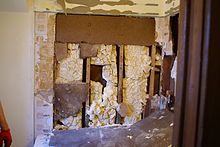
Urea-formaldehyde foam insulation (UFFI) dates to the 1930s and made a synthetic insulation with R-values near 5.0 per inch. UFFI is a foam, like shaving cream, that is easily injected or pumped into walls. It is made by using a pump set and hose with a mixing gun to mix the foaming agent, resin, and compressed air. The fully expanded foam is pumped into areas in need of insulation. It becomes firm within minutes, but cures within a week. UFFI is generally found in homes built before the 1970s, often in basements, crawl spaces, attics, and unfinished attics. Visually, it looks like oozing liquid that has been hardened. Over time, it tends to vary in shades of butterscotch, but new UFFI is a light yellow color. Early forms of UFFI tended to shrink significantly. Modern UF insulation with updated catalysts and foaming technology have reduced shrinkage to minimal levels (between 2 and 4%). The foam dries with a dull matte color with no shine. When cured, it often has a dry and crumbly texture.
Health concerns
Health effects occur when UF-based materials and products release formaldehyde into the air. Generally, no health effects from formaldehyde are seen when air concentrations are below 1.0 ppm. The onset of respiratory irritation and other health effects, and even increased cancer risk, begin when air concentrations exceed 3.0–5.0 ppm. This triggers watery eyes, nose irritations, wheezing and coughing, fatigue, skin rash, severe allergic reactions, burning sensations in the eyes and throat, nausea, and difficulty in breathing in some humans (usually > 1.0 ppm).[6][7] Occupants of UFFI-insulated homes with elevated formaldehyde levels experienced systemic symptoms such as headache, malaise, insomnia, anorexia, and loss of libido.[citation needed] Irritation of the mucous membranes (specifically the eyes, nose, and throat) was a common upper respiratory tract symptom related to formaldehyde exposure. However, when compared to control groups, the frequency of symptoms did not exceed the controls except for wheezing, difficult breathing, and a burning skin sensation. Controlled studies have suggested that tolerance to formaldehyde's odor and irritating effects can occur over a prolonged exposure.[citation needed]
History
UF was first synthesized in 1884 by Hölzer, who was working with Bernhard Tollens.[8] In 1919, Hanns John (1891–1942) of Prague, Czechoslovakia, obtained the first patent for UF resin.[9]
Urea-formaldehyde was object matter of judgment via the European Court of Justice(now CJEU) of 5 February 1963, Case 26–62 Van Gend & Loos v Netherlands Inland Revenue Administration.[10]
| This article uses material from the Wikipedia article Metasyntactic variable, which is released under the Creative Commons Attribution-ShareAlike 3.0 Unported License. |