Syntactic foams are composite materialssynthesized by filling a metal, polymer,[1] or ceramic matrix with hollow spheres called microballoons[2] or cenospheres or non-hollow spheres (e.g. perlite).[3] In this context, "syntactic" means "put together."[4] The presence of hollow particles results in lower density, higher specific strength (strength divided by density), lower coefficient of thermal expansion, and, in some cases, radaror sonar transparency. A manufacturing method for low density syntactic foams is based on the principle of buoyancy.[5][6]

The term was originally coined by the Bakelite Company, in 1955, for their lightweight composites made of hollow phenolicmicrospheres bonded to a matrix of phenolic, epoxy, or polyester.[7]
Tailorability is one of the biggest advantages of these materials.[8] The matrix material can be selected from almost any metal, polymer, or ceramic. Microballoons are available in a variety of sizes and materials, including glass microspheres, cenospheres, carbon, and polymers. The most widely used and studied foams are glass microspheres (in epoxy or polymers), and cenospheres or ceramics[9] (in aluminium). One can change the volume fraction of microballoons or use microballoons of different effective density, the latter depending on the average ratio between the inner and outer radii of the microballoons.
The compressive properties of syntactic foams, in most cases, strongly depend on the properties of microballoons. In general, the compressive strength of the material is proportional to its density.
The matrix material has more influence on the tensile properties. Tensile strength may be highly improved by a chemical surface treatment of the particles, such as silanization, which allows the formation of strong bonds between glass particles and epoxy matrix. Addition of fibrous materials can also increase the tensile strength.[citation needed]
Applications
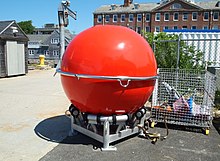
These materials were developed in early 1960s as improved buoyancy materials for marine applications.[10] Other characteristics led these materials to aerospace and ground transportation vehicle applications.[11]Current applications for syntactic foam include buoyancy modules for marine riser tensioners, remotely operated underwater vehicles (ROVs), autonomous underwater vehicles (AUVs), deep-sea exploration, boat hulls, and helicopter and airplanecomponents. Structural applications of syntactic foams include use as the intermediate layer (that is, the core) of sandwich panels.
Other applications include;
- Deep-sea buoyancy foams. A method of creating submarine hulls by 3D printing was developed in 2018.[12]
- Thermoforming plug assist
- Radar transparent materials
- Acoustically attenuating materials
- Cores for sandwich composites[13][14]
- Blast mitigating materials
- Sporting goods such as bowling balls, tennis rackets, and soccer balls.[15]
| This article uses material from the Wikipedia article Metasyntactic variable, which is released under the Creative Commons Attribution-ShareAlike 3.0 Unported License. |